The short answer
For an oil-affected commercial concrete floor, request a contamination assessment and a defined decontamination scope before accepting a coating-only price. Ask what evidence will support coating the affected areas and what happens if the proposed preparation cannot achieve a suitable substrate. Keep the investigation, any concrete repair and the finish package visible as separate purchases.
Map the operating history as well as the visible mark
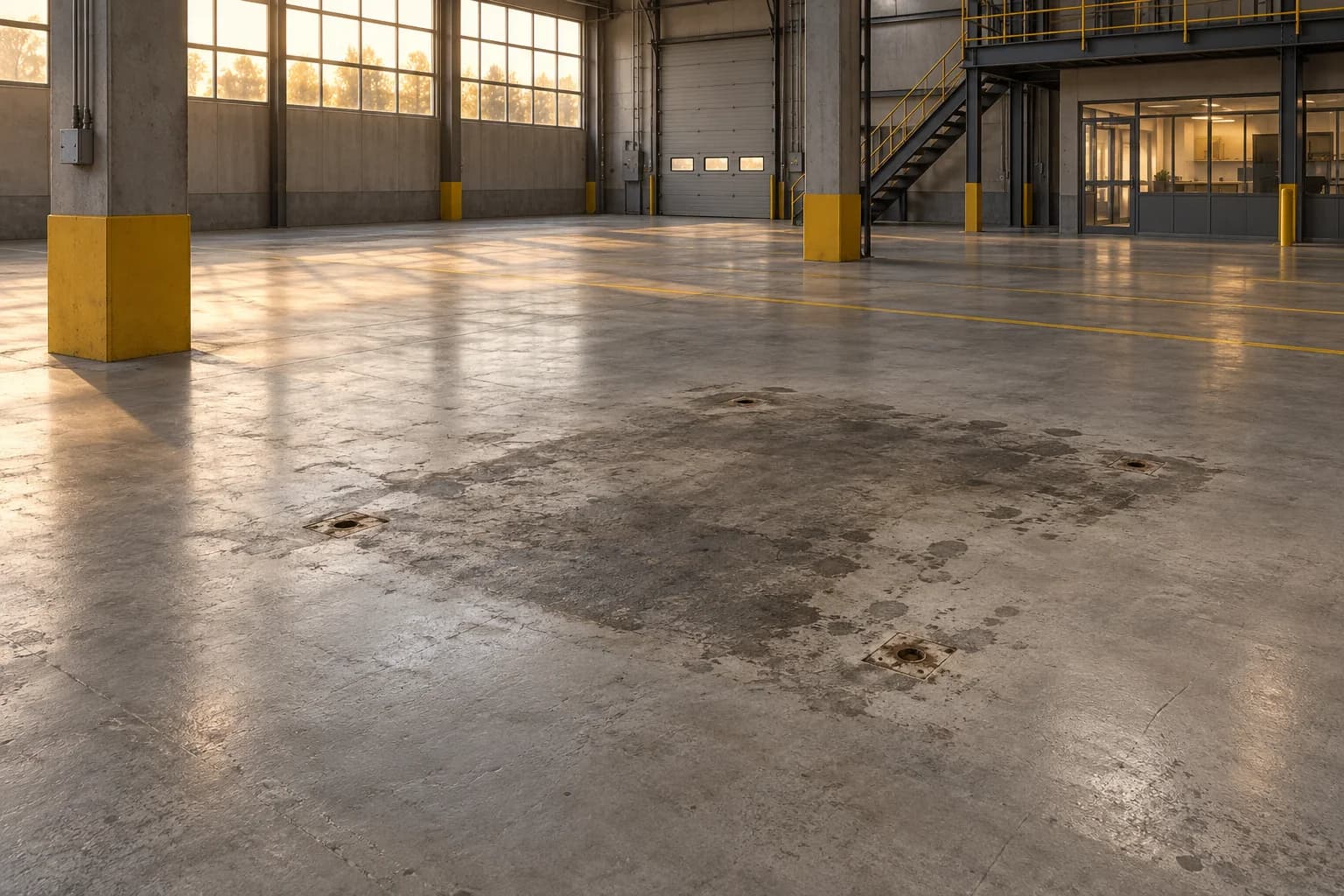
Before a Saskatoon workshop or fleet-service floor is priced, ask the operating supervisor to identify former machines, service positions and recorded spills. Connect known oil or cleaning-product identities to those locations. Keep recollections and confirmed records separate. A dark patch is an observation; ask the assessor to identify its significance rather than declaring its depth or composition from a photograph.
Include areas concealed by equipment and note when they can be assessed. Ask the operator to resolve any continuing source of contamination before the preparation sequence is agreed. If equipment must move, identify who arranges that work and whether the exposed footprint remains an estimating uncertainty. Do not assume the open aisle represents the floor beneath a long-standing machine.
Buy a decontamination scope before a roughness result
Sika's US surface-preparation guide places removal of surface contaminants before creation of a surface profile. It identifies oil and grease among materials that can affect coating adhesion and performance, and notes that porosity and exposure duration influence cleaning. These points support a separate contamination review; they do not prescribe a cleaning method for this floor.
Ask the proposed coating supplier and contractor to define the assessment, preparation and review needed for the actual system. The response should identify affected zones, the party doing the work and the evidence used to decide whether coating can proceed. A quotation for grinding describes an activity but leaves the oil-related acceptance question open unless that question is addressed explicitly.
Leave cleaning chemicals, equipment, sampling and waste arrangements with the qualified project parties. The owner should request a supported scope and its limits, not ask staff to try a solvent or improvise a pass/fail test. A moisture result or a surface-profile comparison should not be relabelled as contamination clearance.
Reference: Sika: decontamination before concrete surface profiling
Price the unresolved outcome before booking the shutdown
Request an initial assessment allowance, the defined decontamination work and the proposed coating work as distinct scope lines. Ask which amounts are firm and which depend on findings. Include who authorizes additional work if the first proposal does not produce an acceptable substrate. Obtain the actual cost and scheduling terms rather than using an assumed contingency percentage.
For an illustrative workshop, the main aisle might have a supported preparation proposal while a former machine footprint remains unresolved. The owner could commission further investigation of that footprint before committing the entire coating package. If concrete removal or replacement is proposed, request its technical basis, boundary and responsible contractor as a separate revision. A darker finish colour is an appearance choice, not an answer to the open substrate question.
Ask whether the job can be divided without compromising the selected system or the business operation. Keep that answer with the shutdown decision. The purpose of staging is to expose the unresolved purchase before the room is unavailable, not to promise that every contaminated slab can be coated after one cleaning visit.
Hand over the accepted area and the remaining limits
Before coating starts, retain the area map, contractor findings, supplier response and authorized scope. Identify any excluded footprint or further investigation. Have the responsible reviewer state what the decision covers so an accepted aisle is not treated as acceptance of every concealed or unassessed area.
Future oil exposure is a separate system-selection question. Give the supplier the operating brief for the finished floor after resolving historic contamination. Bring both records to an industrial coating discussion with PainterzRus and confirm the offered work and specialist responsibilities. This guide does not establish decontamination, testing or concrete-replacement capability, and it does not select a coating product.
Keep this for your project
Your planning checklist
- Map known spills, machine footprints and inaccessible areas.
- Assign any continuing contamination source to the operator for resolution.
- Request system-specific decontamination and review responsibilities.
- Separate investigation, preparation, potential repairs and coating prices.
- Record accepted areas and unresolved limits before the shutdown is committed.
Does an oil-resistant floor coating solve oil already in the concrete?
Do not extend a claim about future service exposure to an unassessed substrate. Ask the supplier to review the existing contamination separately and require a preparation proposal before purchasing the finish.
Put the planning into practice
Download the free quote comparison kit to compare the work behind each price, or build your commercial project brief before requesting an estimate. No email required to use either tool.
Discuss your commercial project
For warehouse or light-industrial work, explore the access, surface-condition and downtime questions covered by our industrial and warehouse coating planning service.
Have a location and a rough scope? Request a commercial painting quote with the details you have. Access, timing and project requirements can then be reviewed for your property.
A planning guide from PainterzRus, a commercial painting business in Saskatoon. Not a site-specific coating specification, safety assessment or price quotation. Confirm requirements for your property before work begins.