The short answer
Before buying a paint upgrade for claimed formaldehyde removal, ask what was tested and how the evidence applies to the proposed room. Keep a coating's own emissions separate from its claimed ability to remove contaminants already in the air. Have the building's indoor-air professional review the proposal; a chamber result alone is not an occupancy clearance or a guarantee of cleaner office air.
Write down the claimed removal benefit
For a Saskatoon commercial office, separate the decorative repaint from any added air-cleaning claim. Identify the named contaminant, the proposed coating and the rooms included. Ask whether the offer concerns the paint's own emissions, removal of a substance from surrounding air or both. Those are different evidence questions even when they appear in the same brochure.
Dulux's Singapore data sheet for Better Living Air Clean Biobased illustrates that distinction: it lists a low-VOC property and separately promotes pollutant removal with a named test reference. This is a regional marketing example, not independent confirmation of its claimed result, Canadian availability or suitability for a Saskatoon office.
Retain the exact supplier wording and qualifications. If the owner is reacting to an indoor-air concern, refer that concern to the building's responsible team before deciding that repainting is the remedy. A smell, a new furnishing or a salesperson's description does not establish which contaminant is present or whether a coating purchase addresses it.
Read the chamber evidence as a defined test
ISO's public abstract for ISO 16000-23 describes a laboratory method for evaluating reduction of formaldehyde and other carbonyl compounds by sorptive building materials, including paints. It uses supply air containing the target compounds and a test-chamber approach. The abstract establishes the type of question the method addresses; it does not certify a particular paint or report a result for this building.
Ask for the actual report supporting the offered product, including the method and edition used. Do not assume that every removal claim uses the ISO method; the supplier must identify its own evidence. Have the indoor-air reviewer examine the tested material, target substance, conditions, duration and reported result. Keep a percentage in its original context rather than presenting it as the expected reduction throughout the office.
Ask what the report does not establish. The review should distinguish a result for a named compound from a broad claim about all pollutants, and a tested sample from the proposed installed finish. Leave laboratory procedure and interpretation to qualified personnel. Staff should not create a makeshift contaminant challenge or use this article as a test protocol.
Reference: ISO 16000-23:2018 public abstract: sorptive-material laboratory testing; full method not reviewed
Ask how the proposed room differs from the sample
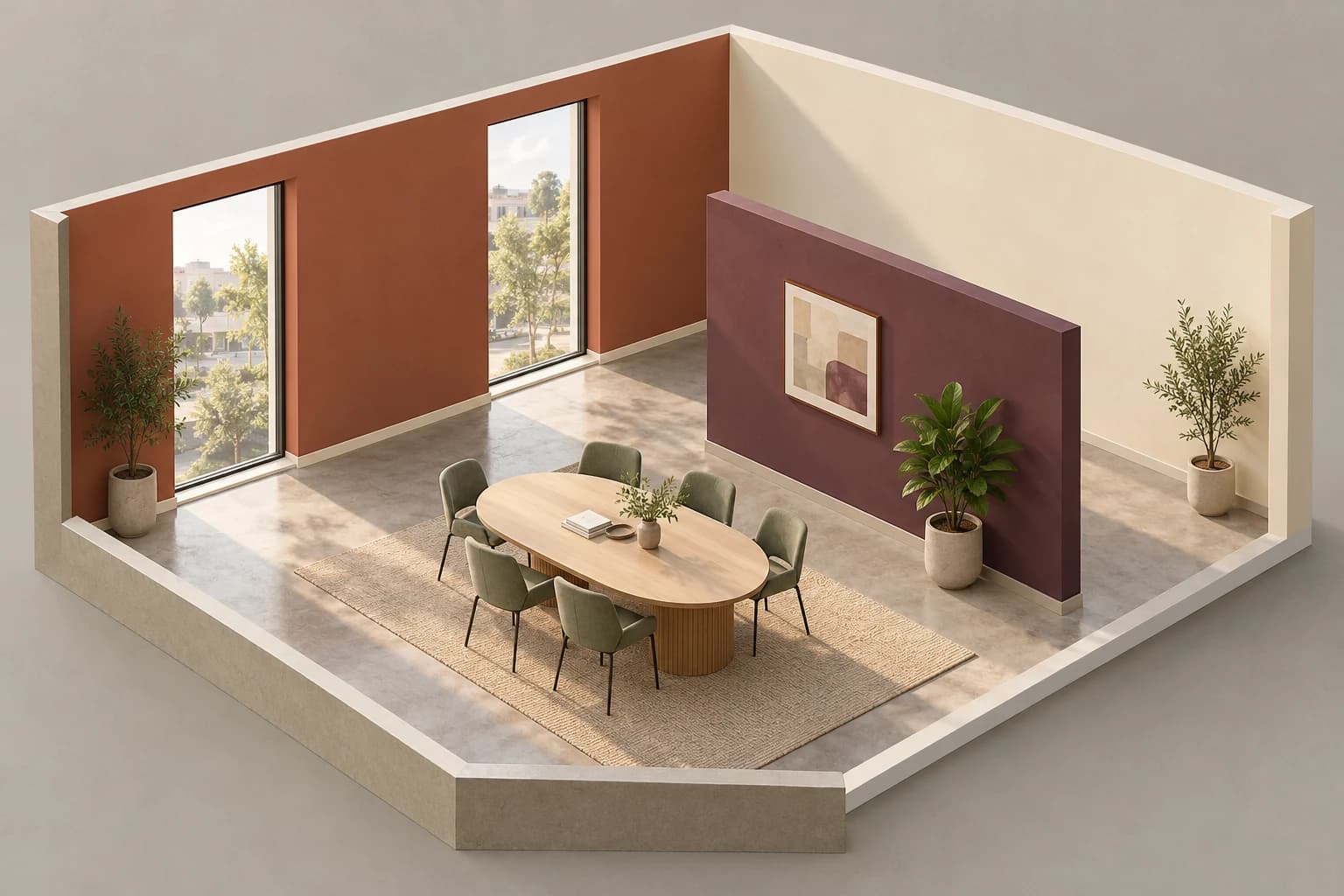
Give the reviewer a room plan showing the proposed painted surfaces, intended furnishings and available building information. Ask what additional information is needed to assess the claimed benefit. Identify surfaces that will remain unpainted or be concealed by fitted furniture. Do not turn total wall area into a performance prediction without a supported explanation.
In an illustrative meeting-room proposal, a supplier's laboratory result might be offered for a room with extensive built-in cupboards and planned ventilation changes. The buying question is whether the actual proposed scope has adequate support, not whether the headline number looks impressive. Have the reviewer identify what can be concluded and what remains unknown before the owner accepts an upgrade.
Request a separate price for the claimed function and any additional assessment. If the evidence supports only the decorative finish for this proposal, the owner can consider that finish on its ordinary merits. A request for more evidence does not prove the product fails; it means the project-level reason for paying for air cleaning has not yet been established.
Keep the paint purchase inside the building's air-quality plan
Health Canada's guidance for office buildings treats indoor air as the result of interacting building, ventilation, source and operating conditions. It calls for reducing contaminant sources and maintaining effective ventilation, with qualified professional involvement where needed. That broader management context should remain in place while any coating proposal is assessed.
Before award, obtain a bounded decision from the responsible reviewer and agree whether any follow-up evaluation forms part of the purchase. State who arranges it and what it is intended to establish. Do not reduce ventilation, defer an identified source remedy or announce the room safe because an air-cleaning finish has been ordered. Product selection and an operational release are different decisions.
Keep the supplier's accepted claim, test reference, room assumptions and final decision together. Review changes to the coating or the proposed room before relying on the same conclusion. Bring the released painting scope to PainterzRus and confirm the work offered. This guide promises no pollutant-reduction percentage, health outcome, indoor-air assessment service or special-product availability.
Keep this for your project
Your planning checklist
- Identify the named contaminant and distinguish removal from the coating's own emissions.
- Obtain the actual report and identify its test method and conditions.
- Ask the qualified reviewer to assess the proposed room and painted area.
- Price the claimed function separately from ordinary decoration and additional assessment.
- Retain the wider air-quality plan and keep occupancy decisions separate.
Does a low-VOC paint label show that the paint removes formaldehyde from the room?
No. Ask for separate evidence of the claimed removal function and have its relevance to the proposed room reviewed. Do not infer air-cleaning performance from a statement about the paint's own VOC content or emissions.
Put the planning into practice
Download the free quote comparison kit to compare the work behind each price, or build your commercial project brief before requesting an estimate. No email required to use either tool.
Discuss your commercial project
For offices, retail spaces and other commercial interiors, review the surfaces, access and protection questions covered by our commercial interior painting in Saskatoon service.
Have a location and a rough scope? Request a commercial painting quote with the details you have. Access, timing and project requirements can then be reviewed for your property.
A planning guide from PainterzRus, a commercial painting business in Saskatoon. Not a site-specific coating specification, safety assessment or price quotation. Confirm requirements for your property before work begins.