The short answer
Before choosing a commercial resin floor, tell the supplier what will stand on it as well as what will travel across it. Request indentation evidence relevant to the proposed system and furniture. Keep temporary deformation, remaining impressions and surface wear distinct in the review. A general hard-wearing claim does not answer every furniture-contact question.
Add stationary contact to the furniture schedule
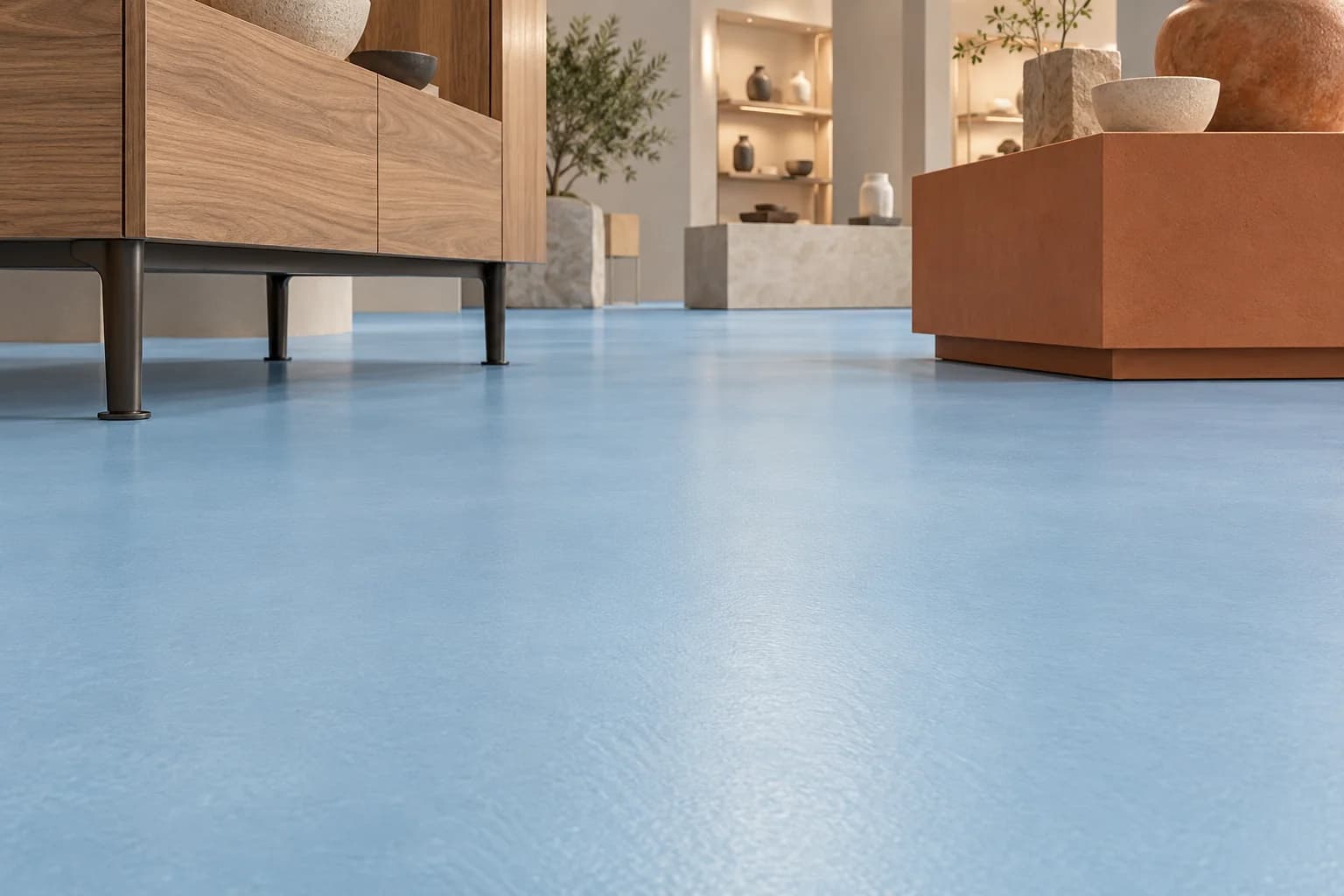
A Saskatoon showroom floor brief often describes foot traffic while saying little about display cabinets that remain in one position. Add those items before selecting the finish. Request available supplier information about their loaded weight, feet or castors and intended placement. Record whether they stay in place or move for seasonal displays. Do not estimate unknown loads from a photograph.
Give the flooring reviewer the furniture schedule alongside the proposed floor build-up. Ask which details need clarification and whether retained underlayers require assessment. Keep the building's structural capacity review separate: this discussion concerns the finish's response at contact points, not permission to place equipment on a slab or upper floor.
If the furniture has not been selected, identify the unresolved purchase. The flooring supplier may need its details before offering a supported recommendation. Assign that dependency to the fit-out coordinator rather than approving a finish on the assumption that any future cabinet will be acceptable.
Separate an impression from wear and moving-furniture damage
Sika's South African Comfortfloor PS-23 system sheet reports indentation, wear resistance, castor-chair resistance and moving-furniture resistance as separate properties. This shows why one attractive result should not stand in for the others. The document is a system-specific example, not a Canadian specification or proof that this system is suitable for your showroom.
Ask each proposer which evidence addresses the stationary furniture in the brief. Obtain the tested system and backing, method reference, loading conditions and reported outcome. Have the supplier explain differences between the tested arrangement and the proposed installation. Keep a missing indentation response open even if the proposal contains a strong abrasion result.
Avoid ranking a hardness number against an indentation depth or a moving-chair result. Ask the technical reviewer which comparisons are meaningful. The owner's practical question is what appearance and function remain after the intended contact, with the limits of the evidence made explicit.
Reference: Sika South Africa: Comfortfloor PS-23, separate performance properties, pages 2–3
Ask when the remaining impression is measured
ISO's public abstract for ISO 24343-1 describes residual indentation in resilient or laminate floor coverings after a constant load has been applied and removed. That distinction helps frame the question about what remains after unloading. The abstract does not supply a complete test procedure or establish which method governs a particular resin-floor purchase.
Ask the reviewer to identify the assessment conditions, including the load duration and any recovery interval relevant to the submitted evidence. Keep a statement about recovery separate from a promise that no mark ever appears. If the supplier proposes a representative trial, agree its purpose, materials, review timing and limitations before arranging it. Do not load a finished floor experimentally to discover its limit.
For an illustrative retail layout, a cabinet may stay in one place until a seasonal display change exposes its former footprint. Ask whether the evidence and supplier advice address that intended use. The example predicts no damage; it identifies the moment when the owner will judge a surface that was previously hidden.
Reference: ISO 24343-1: public abstract on residual indentation after load removal
Approve the floor and furniture conditions together
Request a conclusion linked to the furniture schedule: supported as proposed, further evidence required or a revised arrangement needed. If the supplier recommends different contact fittings or another floor system, obtain a defined proposal. Have the furniture supplier confirm any changes affecting its product. Do not improvise pads, alter equipment feet or assume that a larger contact surface is automatically an approved solution.
Compare the complete supported options, including any fit-out changes and their actual quoted costs. Retain the accepted furniture identities, floor system and appearance limitations in the room record. Refer later substitutions back for review. A new cabinet with a familiar colour is still a different contact arrangement if its support details change.
Bring the reviewed requirements to a PainterzRus commercial coating discussion and confirm the installation scope. Keep structural assessment, specialist testing and furniture modifications with their responsible providers. This guide offers no permitted load, universal indentation limit, product recommendation or mark-free guarantee.
Keep this for your project
Your planning checklist
- List stationary furniture and obtain its available support details.
- Request indentation evidence for the complete proposed floor system.
- Keep wear, movement and remaining impressions as separate review items.
- Clarify loading and recovery conditions behind the reported result.
- Retain the accepted furniture arrangement and review substitutions.
Does a good abrasion result prove that display furniture will leave no impression?
No. Ask for evidence addressing the intended stationary contact and have the supplier explain its relevance. Abrasion, indentation and the supporting floor's structural capacity are separate questions.
Put the planning into practice
Download the free quote comparison kit to compare the work behind each price, or build your commercial project brief before requesting an estimate. No email required to use either tool.
Discuss your commercial project
For warehouse or light-industrial work, explore the access, surface-condition and downtime questions covered by our industrial and warehouse coating planning service.
Have a location and a rough scope? Request a commercial painting quote with the details you have. Access, timing and project requirements can then be reviewed for your property.
A planning guide from PainterzRus, a commercial painting business in Saskatoon. Not a site-specific coating specification, safety assessment or price quotation. Confirm requirements for your property before work begins.