The short answer
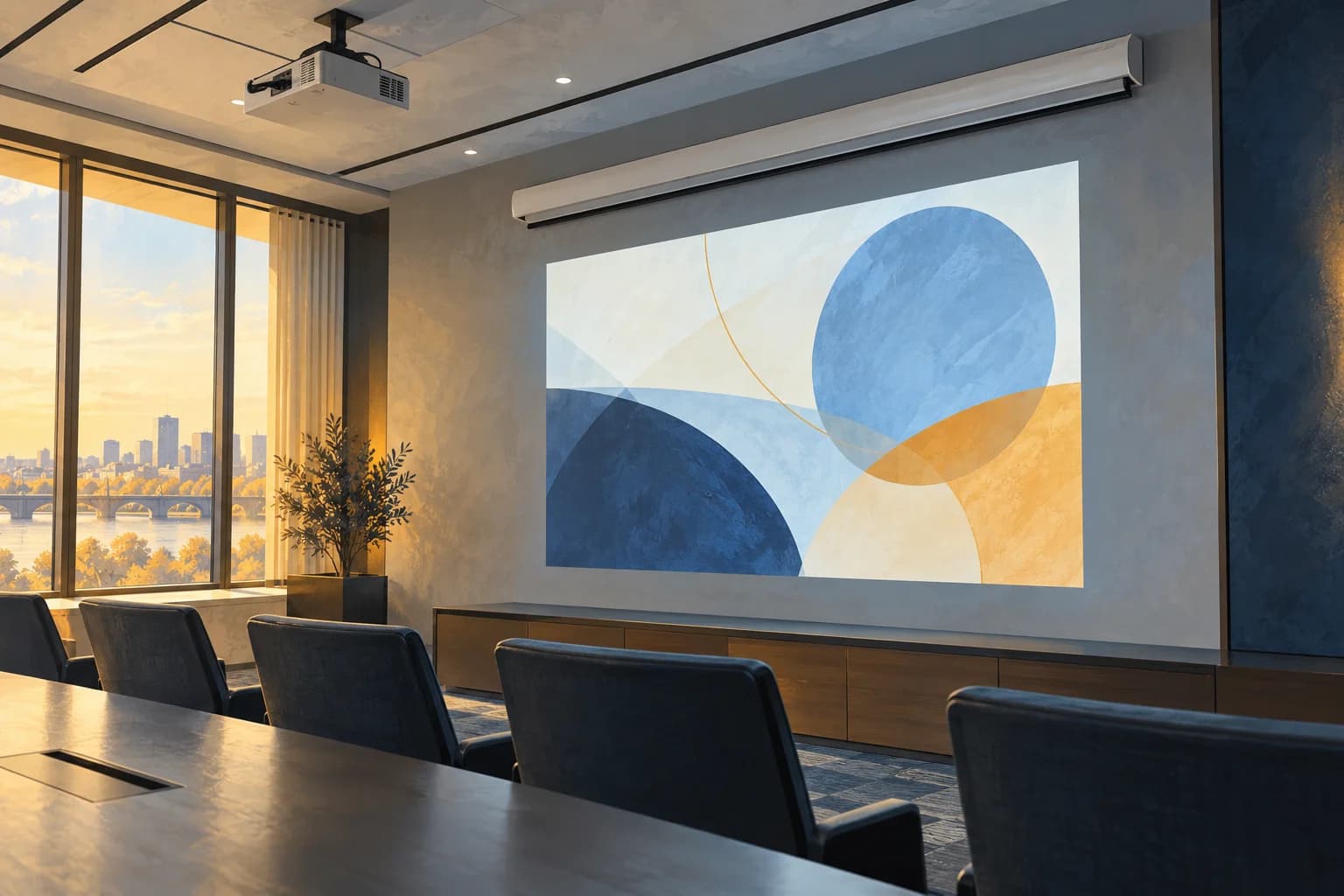
Before adding a projection finish to a commercial repaint, compare the proposed wall and a separate screen against the room's presentation needs. Have the audiovisual reviewer assess the projector, image area, lighting and seating together. Approve a viewing demonstration as well as the wall's appearance; a white paint sample cannot establish that a meeting presentation will be readable.
Describe the presentation the room must support
For a Saskatoon office or commercial training room, begin with the people who run its meetings. Identify whether they show spreadsheets, product photographs, diagrams or video, and which seats must have a useful view. Record the projector model, its planned position and the intended image boundary. Keep missing equipment information unresolved rather than choosing a paint from a photograph of another room.
List the lighting conditions that the business needs during those presentations. A training session may require light for note-taking, while another meeting can use closed blinds. Ask the audiovisual reviewer which conditions must be included in the evaluation. If an option depends on a darker room, obtain the operator's agreement to that arrangement before treating it as an acceptable solution.
Choose a small set of non-confidential presentation files for the review. Include the detail people actually need to read, rather than relying only on a dramatic promotional image. Record the required seating positions and meeting tasks in the purchasing brief. These are owner-defined acceptance questions, not a universal screen-size formula or a technical test standard.
Ask for a projection proposal, not simply a shade of white
Goo Systems' manufacturer FAQ identifies image size, projector light output, ambient light and content as inputs when selecting its projection coatings. It also calls for a flat, smooth receiving surface. Those requirements explain why the proposed finish needs a room and equipment brief. They do not select a product for this building or establish that an ordinary wall paint is interchangeable with a projection coating.
Ask the audiovisual reviewer and coating supplier to identify the proposed system and the information supporting it. Have the painting contractor assess the existing surface and price any required preparation separately. Keep the image rectangle, any border and the surrounding decorative wall as distinct scope entries. The owner may approve the surrounding colour while the projection surface remains undecided.
Request the instructions for the exact proposed coating version. A manufacturer may publish guidance for several systems on the same website; the contractor should identify which instructions govern the purchase. Confirm specialist application capability and local supply directly. This guide does not prescribe a primer, finish colour, coat count or preparation method.
Reference: Goo Systems: projection-coating selection inputs and suitable surfaces
Give the separate-screen option a complete scope
Ask for a comparable screen proposal using the same projector, image area and seating brief. Identify whether the screen stays visible or retracts, who supplies it, who installs it and what adjoining decoration is affected. Include any required mounting review, electrical work and commissioning in the responsible parties' quotations. Compare complete options rather than a tin of coating with a fully installed screen price.
BenQ's screen-selection guide describes fixed and retractable formats and notes that higher-gain surfaces can narrow the useful viewing angle and create uneven bright areas. Its article mainly addresses home entertainment, so its room recommendations and price examples are not a commercial specification for Saskatoon. The relevant question for the audiovisual reviewer is whether the proposed screen serves the actual seats and equipment.
Keep a decision record for each option: required wall work, equipment work, operating-light assumptions, accepted viewing result and unresolved items. Obtain actual quotations once those boundaries are clear. Neither a specialty coating nor a separate screen is automatically the less expensive choice when preparation and installation differ.
Reference: BenQ: screen formats and gain-related viewing tradeoffs; home-entertainment context
Make the demonstration answer the buying question
Agree who arranges a representative demonstration and what it can establish before paying for broad wall work. A small coating sample can support an initial comparison, but ask the audiovisual reviewer how it represents the final image size and viewing positions. Record any limitation instead of treating a sample viewed at arm's length as acceptance from the back of the room.
For an illustrative training room, the centre seats might have an acceptable view while the far-side seats remain unresolved. Ask the reviewer to determine whether the next change belongs to the surface, equipment setup, lighting or room arrangement. Obtain a revised proposal before ordering another coat. This example gives a decision path; it does not diagnose an actual room or promise that paint can correct every presentation problem.
At the agreed review stage, use the selected files under the intended meeting conditions and record the result from the required seats. Name the person accepting presentation use and the person accepting the decorative finish. If the projector or screen location changes, return the viewing decision for review rather than carrying forward approval of a different arrangement.
Keep the selected surface identifiable after handover
Save the approved image boundary, material identity, equipment arrangement and viewing record with the room's finish schedule. Give maintenance staff the applicable care instructions and identify the projection area separately from ordinary wall paint. Ask the supplier how later damage or repainting should be reviewed before authorizing a local repair within that area.
Bring the released wall scope to a commercial interior painting discussion with PainterzRus and confirm the work offered. Audiovisual design, screen installation and specialty projection-coating application require explicit arrangements. The useful purchase is a room whose agreed presentation function has been reviewed, with the decorative work and specialist responsibilities clearly assigned.
Keep this for your project
Your planning checklist
- Record the projector, image boundary, presentation content and required seats.
- Identify the meeting lighting that each option must accommodate.
- Obtain separate preparation, coating and screen-installation scopes.
- Agree a representative viewing demonstration and record its limitations.
- Retain presentation acceptance alongside the decorative finish record.
Can the new white meeting-room wall double as the projection screen?
It may be an option, but assess the actual presentation before accepting it for that purpose. Compare it with a supported projection finish or separate screen using the planned projector, lighting and seats. A decorative colour approval alone does not resolve the viewing requirement.
Put the planning into practice
Download the free quote comparison kit to compare the work behind each price, or build your commercial project brief before requesting an estimate. No email required to use either tool.
Discuss your commercial project
For offices, retail spaces and other commercial interiors, review the surfaces, access and protection questions covered by our commercial interior painting in Saskatoon service.
Have a location and a rough scope? Request a commercial painting quote with the details you have. Access, timing and project requirements can then be reviewed for your property.
A planning guide from PainterzRus, a commercial painting business in Saskatoon. Not a site-specific coating specification, safety assessment or price quotation. Confirm requirements for your property before work begins.