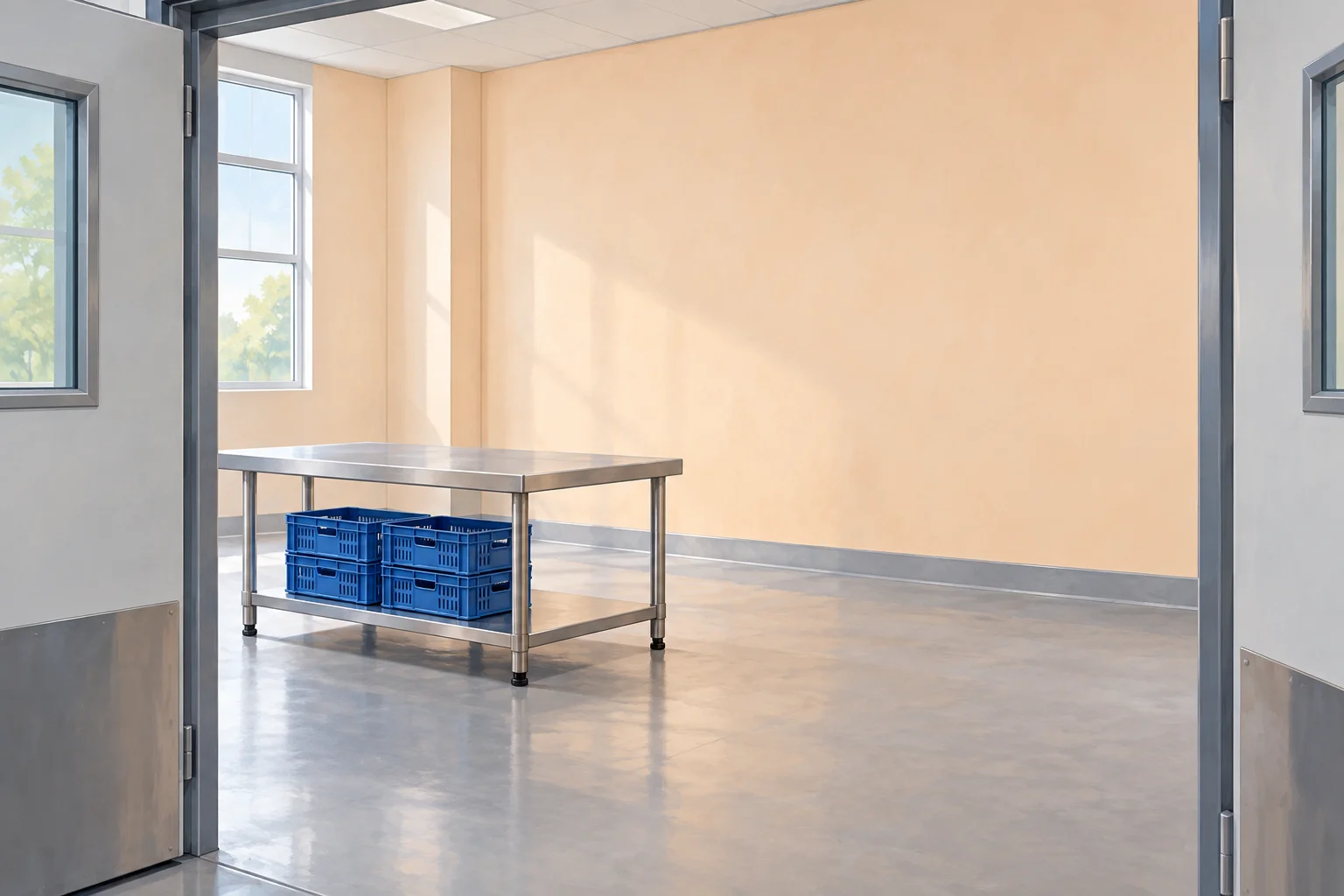
The short answer
For a Saskatoon food facility, have the responsible food-safety reviewer assess the proposed wall coating for its actual intended use before material approval. Ask what the supplier's evidence covers and whether historic acceptance information still corresponds to the product. A general food-safe description is not a facility-specific decision.
Describe the intended location before requesting evidence
Identify the wall surfaces, room activities and relationship to food handling in the proposed repaint. Distinguish a staff office from a packing room rather than requesting one undifferentiated food-facility paint. Have the operator identify the reviewer who decides which evidence is needed. This guide concerns architectural wall coatings, not coatings on utensils or direct food-contact equipment.
Prepare a short use brief for the supplier and reviewer: where the coating would go, the proposed system and the operating conditions the operator wants considered. Keep unknown details open for discussion. The resulting request should describe the intended use clearly enough that a supplier cannot answer with a generic brochure for a different application.
Do not read a historic listing as fresh agency approval
CFIA's construction-material guidance says it no longer pre-approves these materials and that the legacy reference listing is no longer maintained. It recommends checking listing information with manufacturers. Its construction-material category includes interior wall coatings. Treat an old listing reference as a lead for review, not evidence that the agency has newly approved the proposed repaint.
Ask the supplier to identify what historic acceptance is being cited and whether it still describes the product and intended use. CFIA also recommends retaining manufacturer or supplier Letters of Guarantee for construction materials; it states that Health Canada does not issue Letters of No Objection for that category. Have the reviewer choose the appropriate evidence route rather than request a document unavailable for construction materials.
Reference: CFIA: evidence options for construction materials in food establishments
Give the food-safety reviewer a decision, not a slogan
Collect the supplier's response with the proposed material identifiers and the use brief. Ask the reviewer to record whether the information supports that location, needs clarification or leaves the proposal unresolved. Separate that decision from decorative colour approval. A colour sample can help the owner choose an appearance without answering the food-facility suitability question.
For an illustrative packing-room project, a supplier might provide information for a product whose description differs from the quotation. Return the discrepancy for a traceable explanation before purchasing. Do not silently substitute another item or extend one room's decision to every surface. The example is a document-control problem, not a finding that a named coating is suitable or unsuitable.
Carry the accepted use into purchasing and handover
Connect the reviewed material and location to the purchase instruction and contractor scope. If either changes, ask the same responsible reviewer what must be reconsidered. Record who will reconcile supplied materials with the accepted proposal. Keep surface preparation, product compatibility and the operator's return-to-production decision as additional workstreams rather than assuming the evidence package resolves all of them.
At handover, place the final material record and supporting correspondence where the operator can retrieve them for its own review process. Ask the operator to close unresolved differences before describing the submission as accepted. A supplier's letter does not certify an entire facility. This article makes no food-safety certification claim and does not establish PainterzRus's capability for specialist food-processing work; confirm the actual service scope.
Keep this for your project
Your planning checklist
- Define the wall locations and their intended operational use.
- Assign the operator's food-safety reviewer.
- Check historic acceptance claims against current supplier information.
- Resolve material and use discrepancies before purchasing.
- Retain the reviewed evidence and reconcile the installed material record.
Does a reference to an old CFIA listing establish current approval?
Do not treat it that way. The published guidance describes a legacy reference, not an ongoing preapproval system. Ask the supplier and responsible reviewer to establish what the evidence supports for the proposed use.
Put the planning into practice
Download the free quote comparison kit to compare the work behind each price, or build your commercial project brief before requesting an estimate. No email required to use either tool.
Discuss your commercial project
For offices, retail spaces and other commercial interiors, review the surfaces, access and protection questions covered by our commercial interior painting in Saskatoon service.
Have a location and a rough scope? Request a commercial painting quote with the details you have. Access, timing and project requirements can then be reviewed for your property.
A planning guide from PainterzRus, a commercial painting business in Saskatoon. Not a site-specific coating specification, safety assessment or price quotation. Confirm requirements for your property before work begins.